

The World’s Largest Automated Container Port, when Algorithms Take the Helm.

At the heart of global trade, efficiency is paramount,
Every second saved in a port’s operation leads to faster shipments, smoother logistics, and stronger economies.
The Yangshan Deep-Water Port (Phase IV), part of the Port of Shanghai, is the world’s largest fully automated container terminal and a milestone in the evolution of maritime logistics.
At Logistics Insider, where we examine how innovation transforms the movement of goods, this raises an essential question :
Are we witnessing the dawn of an era where algorithms replace human labor, or the next phase of human-technology collaboration in logistics ?
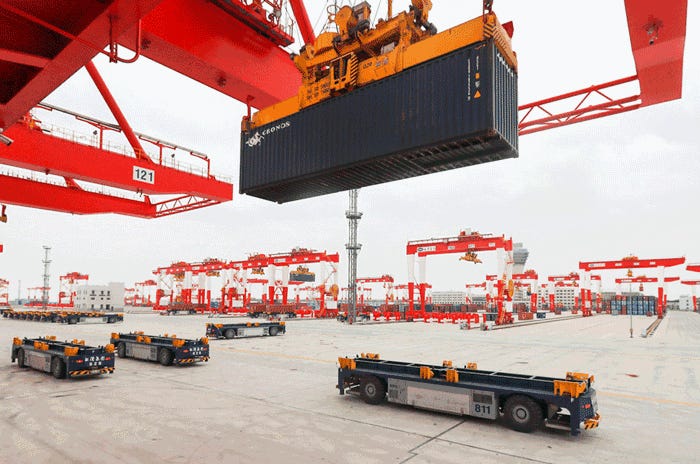
The Concept : Automation Meets Maritime Precision
Located off the coast of Shanghai, Yangshan Deep-Water Port (Phase IV) represents the cutting edge of port automation.
Since beginning trial operations at the end of 2017, the terminal has revolutionized the way containers are handled, combining robotics, artificial intelligence, and data-driven control systems.
Here’s how it works :
Smart Operations : Computer-controlled bridge cranes and automated stacking cranes move containers with millimeter precision.
Autonomous Vehicles : A fleet of Automated Guided Vehicles (AGVs) transports containers across the yard with continuous coordination.
Centralized Management : An automated terminal management system coordinates every step, from unloading ships to stacking containers, optimizing flows and eliminating human error.
The result ? No honking, No strikes, No shouting, No speeding, only the silence of the machines and the precision of the algorithms at work.
Location & Key Features
Location : Shanghai, China
Key Feature : The fourth phase of the port ( the world’s largest automated container terminal ).
Technology : Automation powered by bridge cranes, automated stacking cranes, and AGVs, managed by a real-time terminal control system.
Significance : It strengthens Shanghai’s role as the world’s busiest cargo-handling port and reinforces China’s leadership in global shipping innovation.
The Debate : Efficiency or Over-Automation ?
Supporters see Yangshan as the future of logistics, a vision combining precision, reliability, and scale.
But others wonder what will happen when human adaptability and judgment are replaced by code.
Let’s look at both sides :
The Upside
24/7 operations without fatigue or downtime.
Reduced accidents and operational delays.
Real-time data optimization for vessel turnaround and resource allocation.
The Concerns
High investment and complex maintenance demands.
Fewer job opportunities in traditional port roles.
Potential vulnerability to system errors or cyber threats.
Why It Matters for Global Supply Chains
Automation on this scale is not just a technological showcase ? it is a real game changer in the field of global logistics.
Every improvement in port efficiency has an impact on the entire supply chain, from manufacturing to final delivery.
Key implications :
Faster Turnaround : Ships are processed more quickly, enhancing global trade velocity.
Predictability : Data-driven systems create more reliable shipping schedules.
Sustainability : Electric vehicles and optimized routing reduce emissions and energy consumption.
The Horizon : Humans, Machines, or Both?
The real question is not whether automation works, but how far we will let it go.
Will future ports become entirely self-governing ecosystems, or will human oversight remain essential to resilience and adaptability ?
As logistics professionals, our role is to support this transformation, ensuring that technology amplifies human intelligence without replacing it.
Rethinking Port Logistics
The Yangshan Deep-Water Port (Phase IV) is more than an engineering marvel, it is a symbol of the future of global logistics.
A vision of ports powered by algorithms, operated with precision, and guided by data.
Are we ready for a world where global trade flows are managed by machines and humans become the architects behind the code ?
At Logistics Insider, we’ll keep exploring how automation, infrastructure, and technology converge to shape the supply chain of tomorrow.
Follow Logistics Insider for more insights on automation, global trade, and the future of intelligent logistics.