In emergency response, every second counts, and every decision can mean the difference between control and catastrophe – between safety and sacrifice.
Now imagine a world where firefighters no longer have to confront the flames directly.
Enter the next frontier of firefighting : quadruped robotic systems designed to operate where humans cannot.
At Logistics Insider, where we examine how technology transforms operations, safety, and resilience, this innovation raises a critical question :
Are we witnessing a fundamental shift in the design of emergency response operations, moving from human endurance to robotic precision ?
The Concept : Robotics in Extreme Environments
Firefighting has always pushed human limits. Wildfires, industrial explosions, toxic smoke, collapsing structures, these are environments where risk is unavoidable.
Quadruped firefighting robots are built precisely for these conditions.
Here’s what makes them different :
Extreme-Condition Operations : Designed to function in intense heat, smoke, and hazardous industrial zones.
Advanced Mobility : Four-legged movement allows them to navigate debris, stairs, uneven ground, and unstable terrain.
Heavy-Duty Capability : Able to carry loads, pull high-pressure hoses, and transport firefighting equipment.
They don’t tire, they don’t hesitate, they don’t need oxygen.
Their role isn’t to replace firefighters, but to extend human reach while reducing human risk.
How It Works : From Remote Control to Autonomy
Today, these robotic systems are primarily remotely operated, giving emergency teams real-time control from safe distances.
But the roadmap is clear.
The next evolution includes :
Semi-Autonomous Navigation : Robots identifying safe paths and hazards independently.
Sensor-Driven Awareness : Thermal cameras, gas detection, and structural monitoring feeding live data to command centers.
Future Full Autonomy : AI-powered decision-making for proactive fire suppression and risk containment.
This marks a transition from reactive firefighting to predictive and proactive safety systems.
The Debate : Technological Breakthrough or Operational Challenge ?
As with any major shift, robotics in firefighting sparks debate.
Let’s examine both perspectives.
The Upside
Reduced firefighter exposure to life-threatening conditions.
Continuous operation in environments unsafe for humans.
Improved situational awareness through real-time data.
Faster deployment in hard-to-access zones.
The Challenges
High acquisition and maintenance costs.
Integration with existing emergency protocols.
Training responders to operate and trust robotic systems.
Ethical and accountability questions in autonomous decision-making.
Innovation alone isn’t enough, integration and governance will define success.
Why It Matters for Emergency Management & Operations
Firefighting robots are not just tools, they represent a systemic change in how emergency response is structured.
Scalability in Crisis : Robotics allow consistent performance during prolonged disasters.
Operational Resilience : Reduced dependency on human endurance during extreme events.
Just as automation transformed ports, warehouses, and logistics hubs, it is now redefining safety-critical operations.
The Horizon : Human Courage, Machine Precision
The real question isn’t whether robotics belong in firefighting, It’s how fast systems, regulations, and mindsets can adapt.
Will future firefighting operations be carried out by hybrid teams, composed of humans guiding machines using data and strategies ?
Will autonomy enable earlier intervention, before disasters worsen ?
As professionals in operations, logistics, and risk management, the lesson is clear : the future belongs to systems that protect people while amplifying capability.
Rethinking Emergency Response
Quadruped firefighting robots are more than just a technological advance, they are a statement : safety can be designed, not just endured.
Are we ready to integrate robotics as a frontline asset in emergency response frameworks ?
At Logistics Insider, we will continue to explore how technology, automation, and intelligent systems are reshaping not only supply chains, but also the very definition of operational security.
Follow Logistics Insider for more insights on innovation, automation, and the future of resilient operations.
Thanks for reading Logistics Insider Newsletter by Amine Bouder, Subscribe for free to receive new posts and support my work.
A compelling look at how robotics can shift emergency response from human endurance to system-level safety, with important implications for operations, risk, and resilience


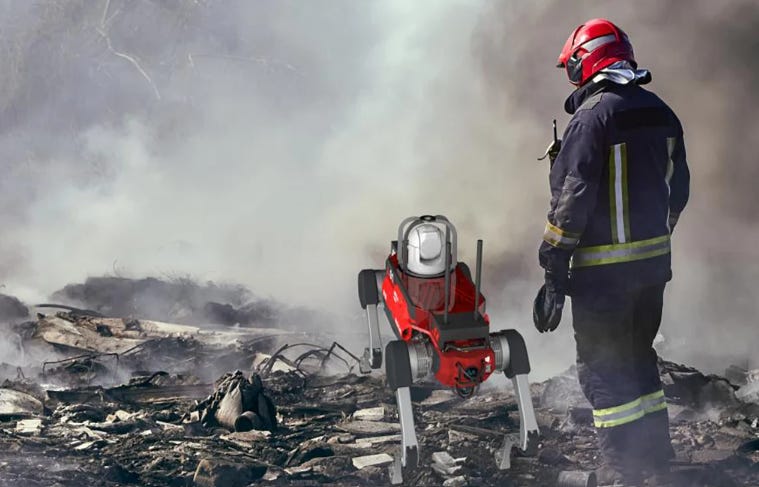
A compelling look at how robotics can shift emergency response from human endurance to system-level safety, with important implications for operations, risk, and resilience